
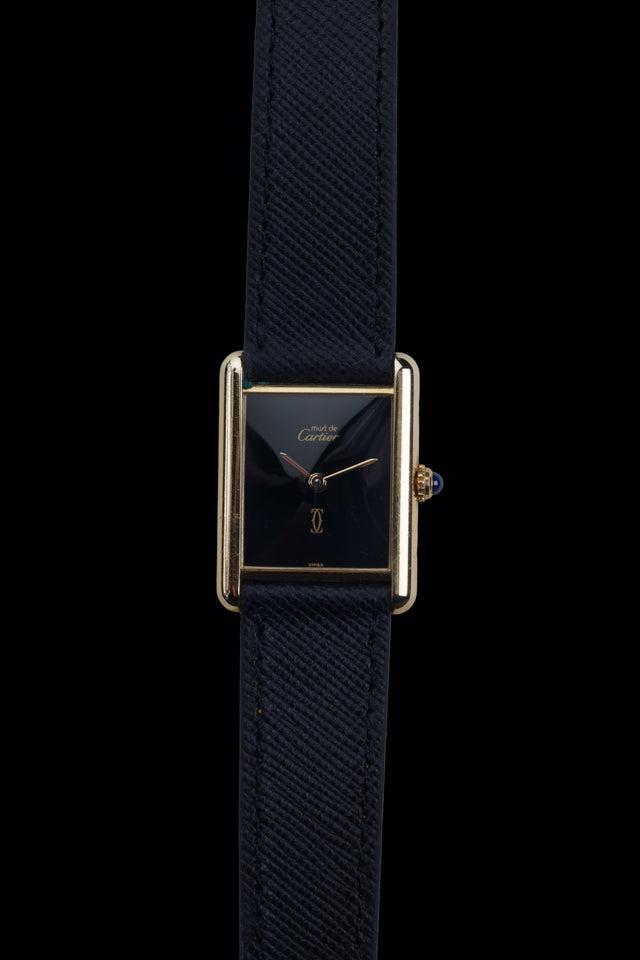


Cartier Paris Tank Gold-Plated Complete Set 1990
Beautiful Cartier classic in full set and wonderful condition Switzerland 1990
# Cartier# Paris Tank ladies' watch
# 925 silver gilded with black dial and golden hands
# Full set with Cartier box, description, and warranty card from March 17, 2000# Original bracelet and new leather strap with pin buckle
# Reference 681006# Serial number # Caliber
# 31mm x 24mm
# Quartz# Around 1990
# Switzerland
The Cartier works perfectly technically and has just been serviced: (°; +6s/d).
The watch shows hardly any signs of use. There are no deep scratches, dents, or similar, the glass is scratch-free.
Cartier is not just “another luxury brand” when it comes to watches – what is special is how consistently Cartier has fused jewellery aesthetics, design history, and watchmaking into its own language. This makes the brand culturally so charged.
1 Origin: Jeweller who treated watches like design objects
Cartier began in 1847 in Paris as a house for jewellery and fine works (not primarily as a classic “watch manufactory”). This origin still shapes the watches today: proportions, lines, materials, and details are often conceived at Cartier as with jewellery – as wearable design.
2 “Jeweller of kings” – early symbolic power and status
Cartier early on became the address for nobility and high society. Famous is the saying that Cartier is the “Jeweller of Kings and King of Jewellers”; in this environment the brand also received royal recognition (including Royal Warrant in Great Britain around 1902). This is an important part of the brand’s meaning: Cartier historically stands for legitimized luxury – not just for price, but for social role.
3 Cartier created icons that made the wristwatch “modern”
Two models tell this especially strongly:
-
Santos (1904): Louis Cartier made it for the aviator Alberto Santos-Dumont so he could read the time while flying – an early, prominent wristwatch idea with a real use case.
-
Tank (1917): Designed by Louis Cartier, formally inspired by the lines of early Renault tanks; the design became a design icon (and thus one of the strongest “watch as cultural object” statements ever).
The point: Cartier is not just “tradition” but formative design – many recognize Santos/Tank at first glance, even without watch knowledge.
4 A unique design language that is immediately recognizable
Cartier popularized features that act like trademarks:
-
Roman numerals
-
Chemin-de-fer minute track (railroad minute track)
-
Blue hands / steel look
-
Cabochon crown (often with sapphire)
-
Courage for geometry (rectangle, square) instead of only round cases
The result is a rare combination: formal enough for a dress watch, but graphic/architectural enough to appear modern in any era.
5 Meaning today: “Quiet luxury” with true history
Cartier watches work as a code: less “technical show” (complications, data sheets), more style, cultural reference, and continuity. That is why many wear Cartier not despite, but because of the restraint: The watch does not say “look what I can do,” but “I have taste.”
If you want, tell me briefly which Cartier line appeals to you (Tank, Santos, Panthère, Ballon Bleu …) and whether you prefer vintage stories or current models – then I will explain the differences (meaning, style, typical sizes/wearing feel) concretely for you.
What our enthusiastic customers say about us
Optionata profile on Chrono24
★★★★★ 5.0 out of 5 stars | Reviews: 87
Our customers on Chrono24
★★★★★ 5.0 out of 5 stars | 89 reviewsDaniel G.Omega Geneve DateThe communication with Mr. Linden was perfect. The watch is exactly as described and inquiries were answered kindly and competently. This certainly won't be the last watch I buy there. I can warmly recommend Optionata if you are looking for a vintage watch.
Kevin N.Breitling Top TimeSeller was very professional and helpful. I have nothing but positive things to say about them.
Jerome T.Heuer Carrera Vintage 3647 DVery nice seller and great experience.
Dominique M.Gallet Multichron 30Everything went to the best satisfaction. The watch was shipped with great care and a beautiful box.
Jens L.Heuer CarreraFast shipping and fantastic packaging!
Jin Lee T.Gallet Multichron 12Super fast and good communication. Highly recommended
Frequently Asked Questions
More here
Optionata Help and FAQ
Frequently Asked Questions